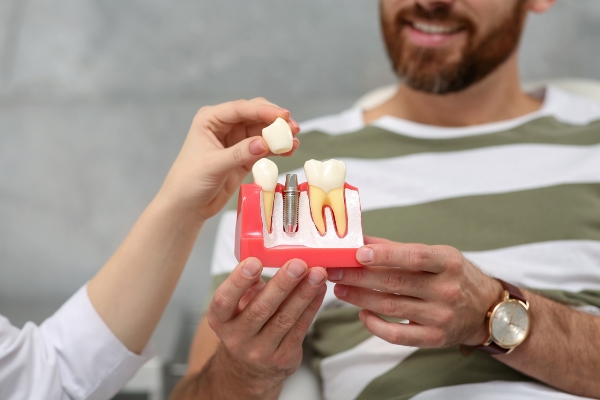
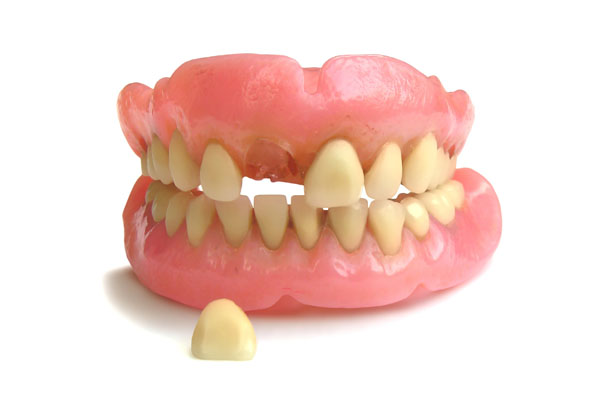
 The purpose of dental restorations is to replace permanent teeth that are lost. This can happen because of trauma to the tooth that renders it irreparable or decay that is so extensive that it requires extraction. There are several restoration options for replacing a missing tooth. Some are removable while others are permanently fixed in the mouth.
What are the effects of a missing tooth?
A missing tooth can make eating more difficult. Food can get stuck in the gap left behind by the missing tooth. Chewing may be less effective, meaning that you have to spend more time making sure each bite is properly softened. Depending on the location of the missing tooth in your mouth, it may also make speech more difficult.
Over time, a missing tooth can cause changes in the mouth. The lack of stimulation from the roots of the tooth can lead to bone loss in the jaw. The other teeth may start to shift inward to close the gap. The tooth opposite the one that is missing may also start to shift downward or upward because the missing tooth is no longer exerting force on it when the jaws come together. All of this can change your bite and potentially lead to further tooth decay and other dental problems.
What dental restorations are available to replace a missing tooth?
There are several dental restorations available to replace one or more missing teeth. Each returns your mouth to its original appearance and function. Some can help prevent the changes that occur in your mouth as a result of missing teeth.
Partial denture
A partial denture is a removable restoration. This means that you can take it out of your mouth for cleaning. Partial dentures consist of a metal framework partially covered by a plastic base with the replacement teeth fixed in it. The plastic base is the same color as your gums, and the replacement teeth are made to blend in with the natural ones. Therefore, it should be very difficult, if not impossible, for other people to tell that you are wearing dentures. Partial dentures attach to your natural teeth by means of a special metal clasp that holds them in place.
Fixed bridge
A fixed bridge consists of one or more artificial replacement teeth that are anchored to either adjacent healthy teeth or by implants in the jawbone. Bridges look and function like natural teeth. While bridges do not prevent bone loss, they do prevent adjacent teeth from shifting.
Dental implants
A dental implant can be used to support a bridge or to replace a single missing tooth. The metal rod implanted into the jaw provides the same stimulation that tooth roots would prevent bone loss. A tooth prosthesis attaches to the implant. Its appearance, function, and care are virtually identical to that of a natural tooth.
Conclusion
Dental restorations return the mouth to approximately the function and appearance it had before the tooth was lost. Some can also help prevent the changes in the mouth that a missing tooth can cause.
Request an appointment or call R. David Brumbaugh, DDS at 214-306-4402 for an appointment in our Dallas office.
Related Posts
People who are looking to improve their smiles often consider the various dental restorations that are available. These restorations can fix a number of issues, including missing, fractured, chipped, decayed, and weakened teeth. The purpose of the procedures is to improve not only the look of the teeth but also their function. Depending on the…
For patients who have damaged or decaying teeth, dental restorations may be a necessity. Dentists use a variety of restorative procedures to protect and repair the structural integrity of an individual's teeth. Some of the most common restoration procedures may include dentures, crowns, and fillings.No individual should suffer from severe tooth pain or discomfort. Decaying…
Dental restorations have been used for thousands of years. In fact, a 2012 article published by The New York Times details the discovery of a 6,500-year-old human jawbone. Considered the earliest evidence of dental fillings, it had beeswax in one tooth, which researchers believe was to ease the pain of a crack. These days, restorations…