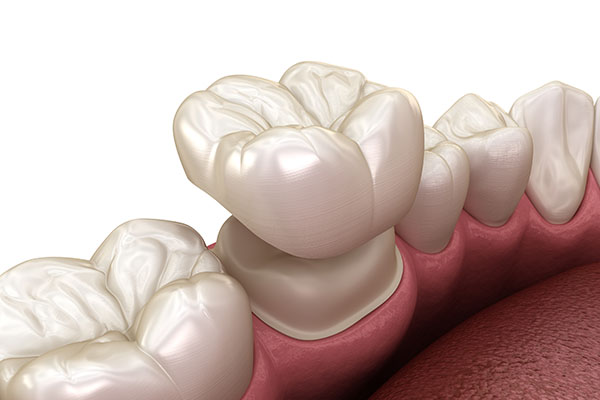
 Dental crowns are a great way to restore the health and appearance of your smile after oral health issues develop. Dental crowns work by surrounding a vulnerable or damaged tooth and offering protection from further damage. Crowns may also be used for teeth replacement purposes as well.
Here is how dental crowns can help the following oral health issues
Several of the more common oral health issues that dental crowns can address include dental cavities, dental trauma, bruxism (teeth grinding), the loss of teeth, and oral (tooth) infections. The following is an in-depth review of why a dentist may use a dental crown in these situations to restore the health and appearance of the patient’s teeth:
Dental cavities
Dental cavities occur when the enamel (the outermost layer of teeth) wears away due to acidic attacks caused by the combination of bacteria and food particles. The ultimate goal is to prevent dental cavities through good oral hygiene and making smart dietary choices. However, more severe cavities that cannot be treated with a dental filling may require a crown. For deep cavities, the patient may need root canal therapy. After a root canal, dentists often place a crown to restore the size of the tooth and protect it from further damage.
Dental trauma
Dental trauma refers to any sudden blow to the face that causes damage to the teeth or gums. For example, someone may suffer a blow to the face during a sporting event that leads to several of their teeth becoming chipped and cracked. When this occurs, dentists often use dental crowns to protect the damaged teeth from further harm and help ensure that the patient does not feel any sensitivity or long-term pain due to the damage.
Bruxism
Bruxism, also called nighttime teeth grinding, occurs in people who clench their jaw while they sleep. Of course, this is unintentional and subsequently hard to control. While many dentists may work with patients to ultimately eliminate bruxism (such as encouraging them to reduce stress, orthodontic treatment, etc.), they can also treat the effects of bruxism by using dental crowns to restore the appearance and health of worn-down teeth caused by grinding.
Teeth loss
Dental crowns are actually one of the most popular (if not the most popular) types of restoration for teeth loss. Dental crowns may be attached to a dental implant or used as a fixed bridge. Dentists may also need to use dental crowns to strengthen adjacent teeth for dental bridge treatment as well.
Tooth infection
A tooth infection can occur as a result of exposure to the tooth’s root, which may result after dental trauma or teeth decay. In this case, a patient may need root canal therapy, and a crown may be placed after a root canal to protect and strengthen each affected tooth long-term.
Talk to a licensed dentist about dental crowns treatment
We encourage you to contact us today if you have remaining questions about how dental crowns can benefit your long-term oral health or would like to schedule a visit.
Request an appointment or call R. David Brumbaugh, DDS at 214-306-4402 for an appointment in our Dallas office.
Related Posts
Dental crowns are durable and effective for restoring damaged or weakened teeth. They improve the tooth's structure and function while also enhancing your smile's appearance. However, proper maintenance can extend their lifespan and ensure long-term oral health. With the right care, these restorations can last several years, providing a reliable and aesthetically pleasing restoration.A consistent…
Dentists use dental crowns to preserve the integrity of the remaining natural dental structure. There are cases when cavities keep getting worse. Lack of routine dental checkups and poor dental care can lead to deeper cavities. This often leads to larger fillings with each dental check. If you want to know how dental crowns can…
Curious about whether you need a dental crown after a root canal? Read on to learn more. Many patients believe that a root canal is a painful procedure and therefore avoid it. In cases of seriously damaged or infected teeth, root canals are the last resort to prevent an extraction. After the root canal treatment,…